Is your walk-in always overcrowded, with products stacked everywhere and one wrong move away from raw and ready-to-eat foods touching? It isn't a cleaning problem. It's a labeling problem, and it often ends in customer complaints, wasted product, and a low score on your inspection report.
The following information will help you understand why labels play a bigger role in a restaurant than many people believe, why factory labels rarely match what a working kitchen needs, and why a thermal transfer label maker lets you print the information you need at the exact moment you need it. You'll also learn which labels are worth printing first, plus answers to the questions kitchen managers ask us most often.
Why a Tidy, Well-Labeled Kitchen Is a Safety Issue, Not a Looks Issue
A clean kitchen looks nice. A kitchen that is labeled actually works. These are two different goals, and only one of them keeps you out of trouble.
⏱️ Speed and Consistency When Tickets Accumulate
Amid the rush of order prep, nobody can recall what is inside each container, let alone its expiration date. Labels turn that into a one-second glance. They prevent wrong dishes from leaving the kitchen, speed up handoffs between prep and the line, and cut down on product discarded because nobody was sure how fresh it was.
🥜 Allergen Control and Cross-Contamination
An unlabeled bottle of sauce is a headache you cannot afford. Allergen mistakes are among the most costly errors in food service, and they usually start small: a decanted bottle, a reused pan, a scoop someone grabbed by accident. Labeling everything properly keeps your staff from making those allergen mistakes in the first place.
✅ Inspection Readiness and Staff Accountability
Date marking is one of the first things an inspector checks, because it shows whether your time and temperature controls are real. Labeling handles that part for you. Add initials next to the date and you get accountability too, since anyone can see who prepped what.
Why Custom Factory Labels Don't Work in a Real Kitchen
Custom-printed labels look great in a catalogue. Reality is different.
📦 Large Minimums You'll Never Use Up
Typical suppliers require several thousand units per design. A small kitchen may need forty "chicken" labels this week and none next week. You end up paying for inventory that sits in a drawer, goes stale, and stops matching your current menu.
⏳ Weeks of Lead Time vs. a Menu Change Tomorrow
Seasonal menu change? New supplier? A limited-time dish you are testing? Factory labels take weeks. Your kitchen changes daily, sometimes by the shift. Any label that cannot keep up with your menu becomes dead stock.
🔒 Fixed Sizes, Colors, and Text
A factory run gives you one size, one color, one phrasing. A kitchen needs a big label for a cambro and a small one for a squeeze bottle. It also needs colors to separate food categories, and the wording has to change whenever your process changes. You should not have to order a thousand labels just to fix one word.
That is the gap a label maker fills. Instead of buying labels on someone else's schedule, you print your own on yours.
Thermal vs. Thermal Transfer: What Survives Heat, Oil, and Moisture?
Before you buy anything, it helps to understand how the two printing methods differ.
🔥 How Direct Thermal Labels Fail
Direct thermal labels print without a ribbon, using heat that reacts with a treated paper coating. That is why you see them on price tags and shipping labels. But the coating keeps reacting after it leaves the printer. Near a steam table, an oven line, or a dish machine, it darkens until the text is gone. Grease softens the adhesive, moisture makes it curl, and a freeze turns it into a blank white rectangle. Fine for short-life retail. Not fine for food safety records.
🛡️ What Thermal Transfer Labels Do Differently
Thermal transfer uses a ribbon that melts ink into the label material instead of into a heat-sensitive coating. That one change means the print stops reacting to the environment around it. Pair it with synthetic stock and you get something genuinely kitchen-grade: resistant to water and oil, legible across a wide temperature range, and still readable 8 to 10 years later when stored properly. High-temperature resistant labels are not a marketing trick. They are a different printing method and a different material.
| What matters in a kitchen | Direct thermal labels | Thermal transfer labels |
|---|---|---|
| Heat from ovens, steam tables, dish machines | Darkens or turns completely black | Print stays legible |
| Water and oil | Ink smears, adhesive lifts | Resists water and oil |
| Freezer and fridge cycles | Fades fast, curls at the edges | Holds up through freeze-thaw |
| How long it stays readable | Weeks at most | Months to years |
| Where it fits | Short-life retail and shipping | Food prep, dates, warnings, equipment |
In short, if your label has to survive a hot, wet, greasy kitchen and still be readable next month, direct thermal will not get you there. Thermal transfer will.
🖨️ Recommended label makers
This is exactly what the NIIMBOT M2 thermal transfer label maker for commercial kitchen food prep is built for. It comes with 50 × 90 mm labels in red, green, blue, and yellow, so you can color-code food categories without ordering custom runs. The labels are waterproof, oil-proof, and stable across high and low temperatures, which makes them a practical fit for prep zones, date marking, and hazard tagging. Need larger labels for big bins or shelf signs? Step up to the NIIMBOT M3, which prints wider formats while keeping the same thermal transfer durability.
Shop the NIIMBOT M2 Explore the NIIMBOT M3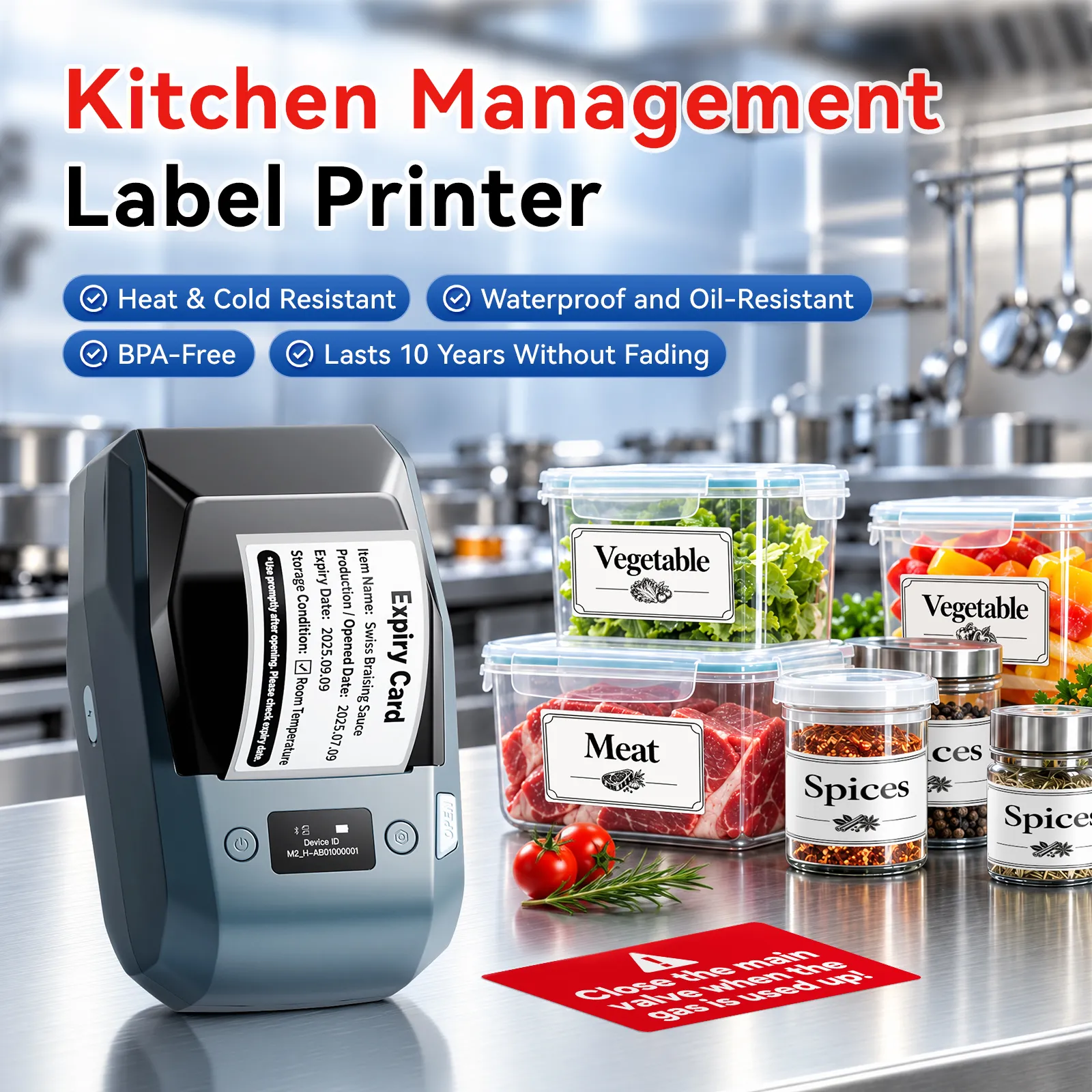
Practical Kitchen Labels You Can Print Now
You do not need to rebuild your whole labeling system. Start with these four categories.
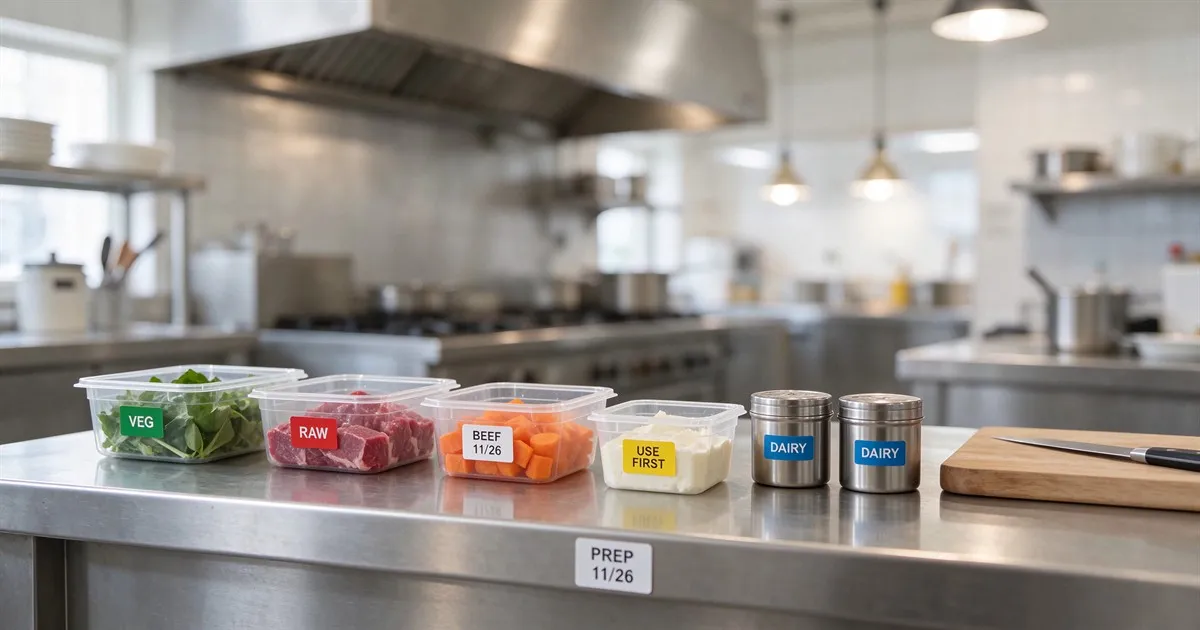
🎨 Raw vs. Ready-to-Eat Zoning with Color Coding
1Give each color one meaning, and post the key on the wall where your team preps — red for raw meat and poultry, green for ready-to-eat food and produce, blue for seafood and dairy, yellow for equipment and warnings.
2Label the container, not just the shelf. Every cambro, pan, and bin gets the color that matches what is inside.
3Enforce the rule that raw food never takes a green label. Color becomes your fastest cross-contamination check.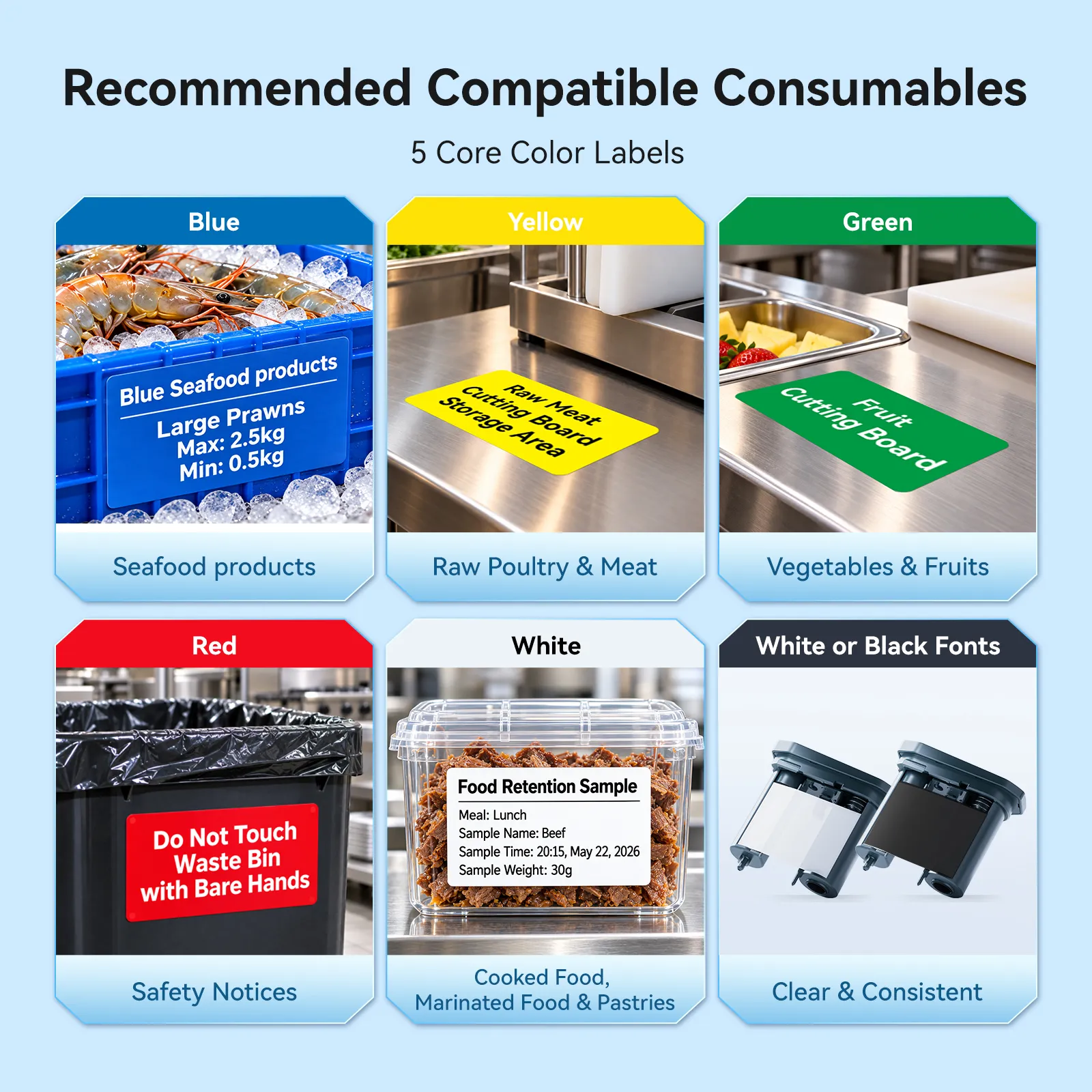
📅 Fridge, Freezer, and Shelf-Life Date Labels
1Print a label the moment product arrives or gets prepped — item name, prep date, and discard date.
2Add initials so anyone can trace who handled it.
3Keep the same format everywhere, so a quick walk-through shows what is fresh and what has to go out next.
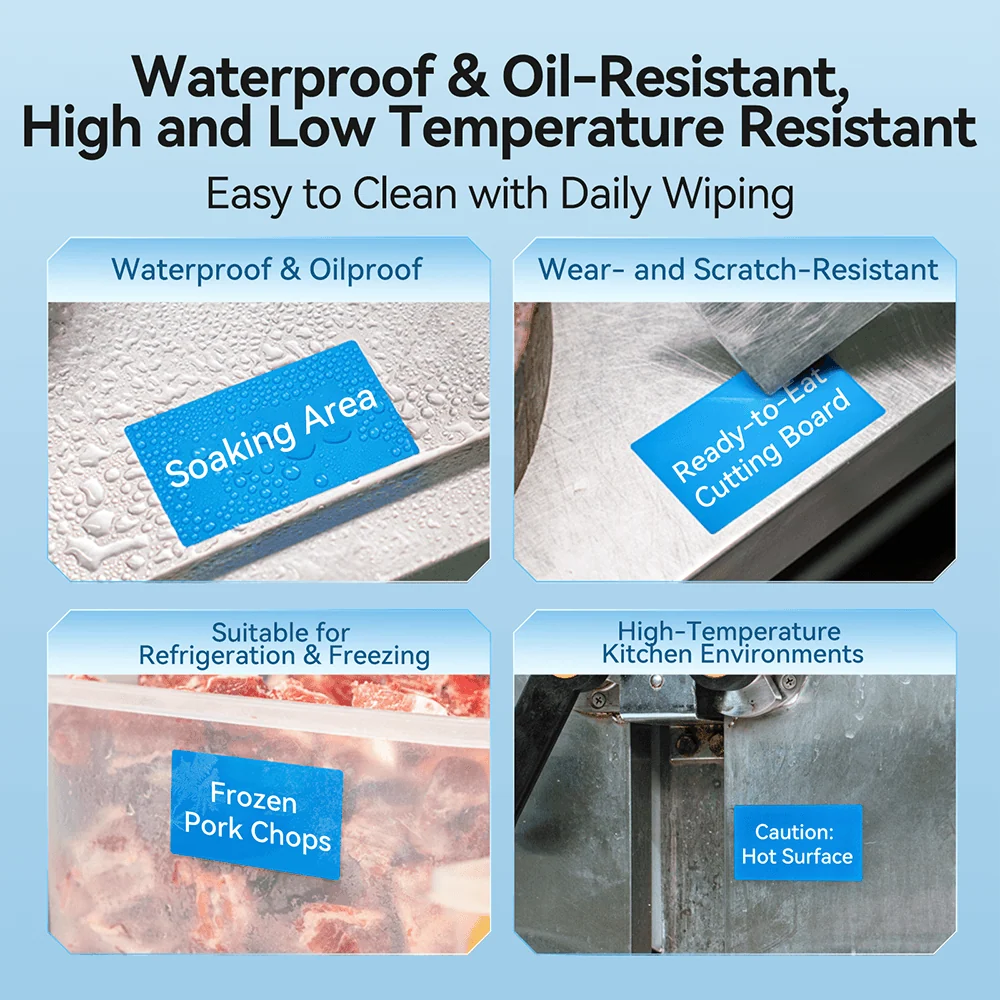
🌡️ High-Temperature Warnings and Equipment Tags
1Tag hot equipment and surfaces with a clear warning — oven doors, steam wells, warming drawers, hot holding units.
2Use high-temperature resistant labels so the warning is still readable after a month of heat cycles.
3Refresh the label whenever the equipment or the hazard changes. That takes seconds on a label maker and weeks through a print vendor.
👤 Staff Belongings, Allergen Callouts, and Rotation Reminders
1Print name labels for staff containers, drinks, and tools so the break room stops being a lost-and-found.
2Add an allergen callout to any container holding one of the top nine allergens, right where your team will see it.
3Put a simple "use first" label on older stock, so FIFO happens without anyone needing to remember it.
FAQ
Are thermal transfer labels food-safe for direct contact?
Treat labels as packaging, not as something that touches the food itself. Label the container, the wrap, or the outer package instead of pressing a label onto the product. Make sure the label material you use is food-contact appropriate for your application, and keep labels off anything that goes directly into a dish.
Will these labels hold up on a steam table, an oven line, or in a blast chiller?
Thermal transfer labels on synthetic stock handle heat, moisture, and cold far better than direct thermal paper, which is why kitchens use them for date marking and equipment tags. No label is indestructible — a direct flame or hours inside a hot oven will defeat anything. In normal prep and holding conditions, they hold up well and stay readable.
Why 50 × 90 mm and four colors — what does each color signify?
The size fits standard prep containers and leaves room for the item, the date, initials, and a short note. The four colors let you build a visual system in minutes: red for raw meat, green for ready-to-eat, blue for seafood and dairy, yellow for warnings and equipment. You decide the mapping — what matters is that everyone on shift reads the same code.
How does the price compare with custom-printed labels?
Cost per label is usually a little higher on a label maker. Total cost is usually lower, because you are not paying for minimums you will never use and you are not throwing away labels for dishes you no longer serve. If your kitchen goes through a few hundred labels a month in mixed designs, printing in-house almost always wins.
Print Your Own Kitchen Labels Tonight
You do not need a consultant, and you do not need to order thousands of custom labels. Just bring one portable label printer into the area that needs work — the walk-in, or the prep station — and print the labels you need on the spot. Once your team sees how convenient it is to print exactly what you need, exactly when you need it, the rest of the kitchen gets tidier and more consistent too.
🖨️ Start with the machine that fits your kitchen
Start with the NIIMBOT M2 for prep zones and four-color date marking, or the NIIMBOT M3 if you want larger labels for big bins and shelf signage. All in all, stop waiting on a factory and start labeling on your own schedule.
Get the NIIMBOT M2 Compare the NIIMBOT M3